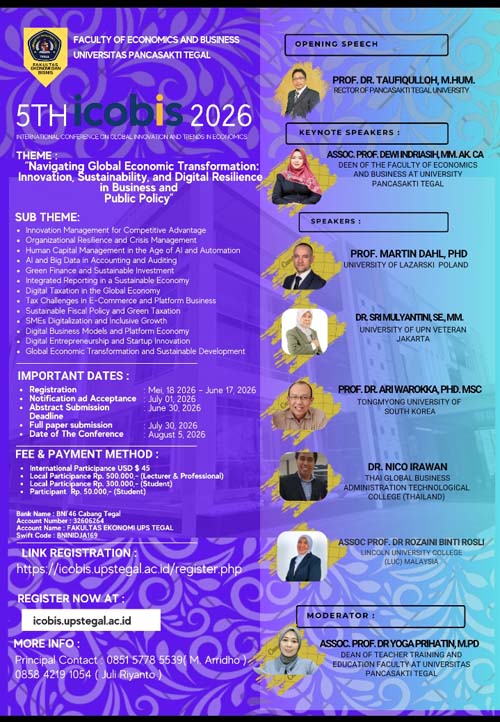
Fintech Adoption And Competitive Advantage As Dual Mediators: Integrating Financial And Marketing Capabilities On F&B Msme Performance
DOI:
https://doi.org/10.24905/icobis.v2i1.26Keywords:
Fintech Adoption, Competitive Advantage, MSME Performance, Financial Capability, Marketing StrategyAbstract
This study proposes an integrated dual-mediation model examining how financial capability and marketing capability jointly influence the performance of food and beverage (F&B) MSMEs in Tegal City and Brebes Regency, Indonesia. Financial technology (fintech) adoption and competitive advantage are proposed as parallel mediating mechanisms. Data from 100 predominantly micro-scale MSME respondents were analyzed using PLS-SEM via SmartPLS 4. Results demonstrate that fintech adoption significantly mediates the impact of financial attitude and financial literacy on financial performance. Similarly, competitive advantage mediates the relationship between perceived quality and price on sales performance. Interestingly, product innovation did not significantly affect competitive advantage due to local consumer preferences for culinary authenticity. Furthermore, the dual-mediation path linking fintech adoption to sales performance via competitive advantage was non significant, highlighting that back-end digital financial tools do not inherently create front-end consumer value. F&B MSMEs must deliberately integrate digital agility with fundamental marketing strategies competitive pricing and product quality for sustainable growth.
References
Amnas, M. B., Selvam, M., & Parayitam, S. (2024). FinTech and financial inclusion: Exploring the mediating role of digital financial literacy and the moderating influence of perceived regulatory support. Journal of Risk and Financial Management, 17(3), 108. https://doi.org/10.3390/jrfm17030108
Ariana, I. M., Wiksuana, I. G. B., Candraningrat, I. R., & Baskara, I. G. K. (2024). The effects of financial literacy and digital literacy on financial resilience: Serial mediation roles of financial inclusion and financial decisions. Uncertain Supply Chain Management, 12(2), 999-1014. https://doi.org/10.5267/j.uscm.2023.12.008
Cohen, J. (1988). Statistical power analysis for the behavioral sciences. Lawrence Erlbaum Associates.
Cravens, D. W., Ingram, T. N., LaForge, R. W., & Young, C. E. (1993). Behavior-based and outcome-based salesforce control systems. Journal of Marketing, 57(4), 47-59. https://doi.org/10.2307/1252218
Dukhaykh, S., & Alangri, N. (2026). Dynamic capabilities and sustainable competitive advantage in SMEs: The roles of innovation and organizational learning. Sustainability, 18(3), 1320. https://doi.org/10.3390/su18031320
El Chaarani, H., Vrontis, P. D., El Nemar, S., & El Abiad, Z. (2022). The impact of strategic competitive innovation on the financial performance of SMEs during COVID-19 pandemic period. Competitiveness Review: An International Business Journal, 32(3), 282-301. https://doi.org/10.1108/CR-02-2021-0024
Hair, J. F., Hult, G. T. M., Ringle, C. M., & Sarstedt, M. (2022). A primer on partial least squares structural equation modeling (PLS-SEM). Sage Publications.
Henseler, J., Ringle, C. M., & Sarstedt, M. (2015). A new criterion for assessing discriminant validity in variance-based structural equation modeling. Journal of the Academy of Marketing Science, 43(1), 115-135. https://doi.org/10.1007/s11747-014-0403-8
Hj Talip, S. N. S., & Wasiuzzaman, S. (2024). Influence of human capital and social capital on MSME access to finance: Assessing the mediating role of financial literacy. International Journal of Bank Marketing, 42(3), 458-485. https://doi.org/10.1108/IJBM-04-2023-0214
Irimia-Dieguez, A., Velicia-Martin, F., & Aguayo-Camacho, M. (2023). Predicting Fintech innovation adoption: The mediator role of social norms and attitudes. Financial Innovation, 9(1), 36. https://doi.org/10.1186/s40854-022-00434-6
Jaaffar, A. H., Abd Majid, N., Kasavan, S., Isa, A., Alwi, M. N. R., & Zahari, A. R. (2024). The effect of innovative mindset and behavior on innovation performance and competitive advantage: A case of halal SMEs owner-managers from Malaysian energy-intensive industry. Journal of Innovation and Entrepreneurship, 13(1), 1-19. https://doi.org/10.1186/s13731-023-00359-z
Kurniasari, F., Abd Hamid, N., & Lestari, E. D. (2025). Unraveling the impact of financial literacy, financial technology adoption, and access to finance on small medium enterprises business performance and sustainability: A serial mediation model. Cogent Business & Management, 12(1), 2487837. https://doi.org/10.1080/23311975.2025.2487837
Kurniasari, F., & Lestari, E. D. (2024). Development of financial literacy and fintech adoption on women SMEs business performance in Indonesia. Eastern-European Journal of Enterprise Technologies, 5(13(131)), 67-75. https://doi.org/10.15587/1729-4061.2024.312613
Kurniasari, F., Lestari, E. D., & Tannady, H. (2023). Pursuing long-term business performance: Investigating the effects of financial and technological factors on digital adoption to leverage SME performance and business sustainability-Evidence from Indonesian SMEs in the traditional market. Sustainability, 15(16), 12668. https://doi.org/10.3390/su151612668
Lontchi, C. B., Yang, B., & Shuaib, K. M. (2023). Effect of financial technology on SMEs performance in Cameroon amid COVID-19 recovery: The mediating effect of financial literacy. Sustainability, 15(3), 2171. https://doi.org/10.3390/su15032171
Lusardi, A., & Mitchell, O. S. (2014). The economic importance of financial literacy: Theory and evidence. Journal of Economic Literature, 52(1), 5-44.
Maghfiroh, R. U., Djatmika, E. T., Handayati, P., & Wardoyo, C. (2025). Adoption a payment fintech service by food and beverage MSMEs: Evidence from east Java Indonesia. Edelweiss Applied Science and Technology, 9(6), 242-252. https://doi.org/10.55214/25768484.v9i6.7791
Munasib, N., & Fitriyah, F. (2025). Synergy of financial literacy and fintech: Improving MSME performance through financial inclusion. Journal of Accounting, Finance, and Management, 6(3), 727-743. https://doi.org/10.35912/jakman.v6i3.4407
Nazhifan Adilfi, N., & Yuldinawati, L. (2024). The influence of innovation and product quality on the competitive advantage of Compass products. Journal Eduvest, 4(9), 7983-7995. https://doi.org/10.59188/eduvest.v4i9.17486
Podsakoff, P. M., MacKenzie, S. B., Lee, J. Y., & Podsakoff, N. P. (2003). Common method biases in behavioral research: A critical review of the literature and recommended remedies. Journal of Applied Psychology, 88(5), 879-903. https://doi.org/10.1037/0021-9010.88.5.879
Porter, M. E. (1985). Competitive advantage: Creating and sustaining superior performance. Free Press.
Pusung, C. S., Narsa, N. P. D. R. H., & Wardhaningrum, O. A. (2023). Innovation, competitive strategy and MSME performance: A survey study on culinary SMEs in Indonesia during the COVID-19 pandemic. Business: Theory and Practice, 24(1), 160-172. https://doi.org/10.3846/btp.2023.16676
Rubio-Andres, M., Linuesa-Langreo, J., Gutierrez-Broncano, S., & Sastre-Castillo, M. A. (2024). How to improve market performance through competitive strategy and innovation in entrepreneurial SMEs. International Entrepreneurship and Management Journal, 20(3), 1677-1706. https://doi.org/10.1007/s11365-024-00947-9
Schumpeter, J. A. (1934). The theory of economic development. Harvard University Press.
Sudjatmoko, A., Ichsan, M., Astriani, M., Mariani, & Clairine, A. (2023). The impact of COVID-19 pandemic on the performance of Indonesian MSME with innovation as mediation. Cogent Business & Management, 10(1), 2179962. https://doi.org/10.1080/23311975.2023.2179962
Widjayanti, C. E., Adawiyah, W. R., & Sudarto. (2025). Financial literacy innovation is mediated by financial attitudes and lifestyles on financial behavior in MSME players. Journal of Innovation and Entrepreneurship, 14(1), 57. https://doi.org/10.1186/s13731-025-00525-5
Zeithaml, V. A. (1988). Consumer perceptions of price, quality, and value: A means-end model and synthesis of evidence. Journal of Marketing, 52(3), 2-22. https://doi.org/10.1177/002224298805200302